

Search
What is collective intelligence?
Collective intelligence is the capacity of human communities to evolve towards higher order complexity and harmony, through such innovation mechanisms as variation-feedback-selection, differentiation-integration-transformation, and competition-cooperation-coopetition-
Join 830 other subscribers
Categories
- 4-Fold Ecosystem
- Academic Research in CI
- AI
- and CI
- Autonomy
- Autonomy, Communion, and CI
- Blogging for Emergence
- C I & All Quadrants All Levels
- Chaordic Chat
- CI & Communities of Practice
- CI & Consciousness
- CI Basics
- CI of Open Source
- CI Principles
- CI Within
- Co-intelligent Economy
- Cognitive Relations
- Collaborative Sense-Making
- Collaborative Taxonomy
- Collective Intellect Augments Individual
- Collective Objectivity
- Collective Wisdom
- Communion
- Community of CI Practitioners
- Connecting Our Conversations
- Contemplative Practice
- Definitions
- Democracy and CI
- Earth Commons
- Events
- Evolutionary Movement
- Evolutionary Threshold
- From States to New Stage
- Global Brain
- Global Challenge
- Hypertinence
- Imaginal Cells
- Infinite Game
- Intelligence
- Intersubjectivity
- Knowledge Ecology
- Leaning into the Unknown
- Literature
- Local to Global to Local
- Mental Modeling
- Methodologies associated with CI
- Movement Cartography
- Movies and videos
- Multi-community membership
- Pattern Language
- Politics and CI
- Presencing
- Questions Worth Asking
- Reboot
- Shared Attention
- Shared Mindfulness
- Singularity
- Songs
- Spiral Dynamics & the Colors of CI
- Synchronicity and CI
- Technologies That Support CI
- Thomas Hübl
- Time, attention, bandwidth & CI
- Towards an attention economy of CI
- Truth of Impersonality
- Uncategorized
- Visualizing Our Ecosystem
- Ways of Tuning with Collective Consciousness
- We-Space
- 3D mindmapping
- amplifying complexity
- attenuating complexity
- augmented reality
- autonomous commons groups
- autonomy
- blogs wikis
- Chaordic Chat
- co-inspiration
- co-sensing
- co-tweeting
- collaborative sense-making
- collaborative video editing
- collaborative video making
- collective intelligence
- collective learner
- collective sensing organ
- collective sentience
- collective wisdom
- commend-and-control
- community
- compacting
- compassion
- complexity
- corporate refugees
- courage
- data
- democratizing complexity
- differentiation
- disruptive social practices
- distant proximities
- distributed cognition
- Drupal
- ego
- epistemic break
- evolution's trick
- Gaia management
- Google Wave
- harvesting
- hierarchy
- holopticism
- Indra's Net
- information
- junto
- luminous moment
- mapping the future
- media wall
- memetic flows
- metabeing
- methodology
- organizing work
- practice
- practice worth replicating
- presencing
- process
- prototyping
- relevant cognitive unit
- scaling up collective intelligence
- shared attention
- social body
- social media
- social media jedi
- social network
- Social Presencing Theater
- social tetrahedron
- Society 2.0
- talent retention
- taxonomy
- theater
- trustnet
- value memes
- virtual nation
- Web 2.0
-
Recent Activity
Archives
- July 2023
- October 2022
- July 2021
- June 2021
- April 2021
- June 2020
- September 2019
- July 2019
- May 2019
- April 2019
- September 2018
- August 2018
- January 2018
- October 2017
- September 2017
- January 2017
- September 2016
- August 2016
- June 2016
- January 2016
- October 2015
- September 2015
- June 2015
- March 2015
- February 2015
- January 2015
- December 2014
- November 2014
- October 2014
- September 2014
- April 2014
- February 2014
- January 2014
- December 2013
- September 2013
- August 2013
- July 2013
- June 2013
- April 2013
- March 2013
- February 2013
- October 2012
- September 2012
- July 2012
- February 2012
- December 2011
- May 2011
- April 2011
- March 2011
- January 2011
- July 2010
- June 2010
- May 2010
- April 2010
- December 2009
- October 2009
- September 2009
- August 2009
- July 2009
- April 2009
- November 2008
- October 2008
- September 2008
- August 2008
- July 2008
- April 2008
- March 2008
- January 2008
- November 2007
- October 2007
- September 2007
- August 2007
- May 2007
- February 2007
- January 2007
- November 2006
- October 2006
- August 2006
- July 2006
- June 2006
- May 2006
- April 2006
- October 2005
- September 2005
- August 2005
- June 2005
- May 2005
- April 2005
- March 2005
- February 2005
- January 2005
- November 2004
- October 2004
- August 2004
- July 2004
- June 2004
- May 2004
- April 2004
- January 2004
- December 2003
- August 2003
- July 2003
- June 2003
- May 2003
- April 2003
- March 2003
- February 2003
Meta
-

Ce(tte) oeuvre est mise à disposition selon les termes de la Licence Creative Commons Paternité 2.0 Belgique.
Jacob Foster. Made to Know: Science as the Social Production of Collective Intelligence | UC Berkeley Sociology Department
Posted in Academic Research in CI
Leave a comment
A Fifteen Days Immersion in Madrid’s European Civic Hall – Open Source Politics – Medium
As part of a two-weeks hackathon on collective intelligence for democracy, Virgile Deville (Open Source Politics / Democracy Earth) went to…
Source: A Fifteen Days Immersion in Madrid’s European Civic Hall – Open Source Politics – Medium
Posted in Democracy and CI, Uncategorized
Leave a comment
Mapping as Commons
This blogpost was written and originally published by Silke Helfrich in the CommonsBlog.

Mapping the World through Commoning for the Federated Commons
Maps shape our perception, they direct our transitions and they inform our decisions. Who doubts the power of mapping, might think of google-maps‘ impact on the lives of the many; not all, because there is an alternative: Open Street Map. The difference between the two becomes cristal-clear when asking: Who owns the maps? Who owns the data? And who reaps the benefit?
Open Street Map is based on free software. It is owned and governed by you. It is constantly in the making, and open to all those who wish to contribute to it on the basis of the collective Open-Street-Map-community-criteria. Open Street Map is the topographic sister of Wikipedia.
When TransforMap was initiated, back in 2014, the community was seeking to combine the Open Street Map approach with the ambition of making the plethora of socio-economic alternatives – TAPAS: There Are Plenty of AlternativeS – visible. We wanted to add to the many crowdsourced maps a possibility to see TAPAs unfolding at a glance, all at once, at people’s devices, in a userfriendly way without being patronizing nor concentrating data. That was and still is TransforMap’s ambition: to challenge both: the dictatorship of corporate-owned data and the cultural hegemony of a an economy stuck in a neoliberal or neoclassical Market-State framework through bringing plenty of Alternatives to everybodie’s attention, among them: the Commons.
Countless mapping projects around the world have similar ambitions. Just as TransforMap they are committed to enhance the visibility and impact of all those projects, initiatives and enterprises who contribute to a free, fair and sustainable future. However, most of them receive only small attention in mainstream media and general culture, because they are
# utterly disconnected from each other
# partly enclosed on proprietary platforms – like google maps
# built on different taxonomies and
# (luckily) highly diverse in their mapping approach
In short: not interoperable.
Working towards interoperability of the countless alter-maps is widely perceived as a key element for enhancing their impact. Thus, the need for a convergence and for atlassing maps based on a ‚Mapping as a Commons‚as opposed to ‚Mapping the Commons‘. The former is a mapping-philosophy and crucial for destilling the governance principle of emancipatory mapping projects, the latter is just one out of many ‚objects‘ or ‚items“ to be mapped.
The following lines roughly sketch out our understanding of ‚Mapping as a Commons“. Later on, they might turn into a manifesto for ‚Mapping asCommoning‚ for many many maps and through a multitude of mappers.They are written in an inimperative manifesto form, to be used from now on as a guideline or quick analytical tool to evaluate the own mapping practices.
Mapping as a Commons, what does it mean? (0.2)
The following is based on the raw notes from Commons Space atWSF 2016 and an initial summary by @almereyda. The principles are the condensate of globally dispersed, locally found initiatives which collaborate for building and maintaining a shared mapping commons.
1. Stick to the Commons: as a goal and a practice
The challenge is twofold: contribute to the Commons as a shared resource and do it through commoning. Your mapping project is not a deliverable, nor a service-product to compete on the map-market. Hence, it is paramount to systematically separate commons and commerce and to integrate the insigths (patterns?) of successful commoning-practices into your mapping initiative. Strive for coherence at any moment!
2. Create syntony on the goal
Discuss your common goal and your understanding of „mapping as commoning“ again and again. And again! Everybody involved should resonate on the essentials and feel in syntony with mapping for the Commons through commoning at any time.
3. People’s needs first
Maps provide orientation to common people but also visibility of power and policy-driven agendas. Make sure your map doesn’t feed the power-imbalances. People’s needs trump desires of institutions, donors or clients.
4. Keep an eye on interoperability and use web technology
To map as a commoner implies caring for other mappers needs and concerns. You will take them into account through dialogue with partner-mappers and make sure interoperability is a shared goal.
[5.Contribute to the Federated Commons
Mapping the World through Commoning is a double contribution: among commons projects and initiatives toward a Federate Commons and between Commons projects, solutions or initiatives and other socio-economic alternatives.]
6. Provide open access
Always. To everything.
7. Use free software
Work with free software at all levels is critical, as it is not about the freedom of the software, but about your freedom to further develop your mapping projects according to your own needs.
8. Self-host your infrastructure
Only use technology which allows to be replicated quickly as for instance [@almereyda ?]. Eat your own dogfood [@almereyda, what does it mean?], and document transparently, how you do it. Transparent documentation means understandable documentation.
9. Build on open technology standards
Ensure your map(s), its data and associated mapping applications can be reused on a wide diversity of media and devices. Ergo: hands off proprietarian technologies and their standards. Don’t think about them not even as interim solution. If you do, you risk to add one interim to another and get trapped into dependencies.
10. Make sure you really own your data
‚Mapping as a Commons‘ strives for mapping souvereignity at all levels. In the short run, it seems to be a nightmare to refrain from importing data for geolocation or copying & pasting what you are not legally entitled to. In the long run, it is the only way to prevent you being sued or your data being enclosed. Make sure you really own your data. It prevents you from the real nightmare of at some point loosing your data without being able to do something against.
11. Use free open data licenses
To own your data is important, but not enough. Make sure nobody dumps your common data back into the world of marketization and enclosures. What is in the Commons must remain in the Commons. Free licences protect the result of your collective work at any moment. Make use of them. It’s simple.
12. Guarantee the openness of taxonomies
A taxonomy is incomplete as a matter of fact. It is one out of many entry points to complex social worlds. The more you learn about these worlds the better you can adjust your taxonomy. An open taxonomy allows your peer mappers and users to search it for a concept, link them -via tag- to a parent category, to add missing concepts if you allow for or to merge tag structures.
13. Make the Data Commons thrive through your usage
Link to WikiData and OpenStreetMap from the beginning! It’s just nonsense to maintain your single data set. There is so much to benefit from and contribute to the data commons. Explore abundance and contribute loads to our shared data.
14. Care for your Data Commons
Strive for accuracy and remember at the same time, that there is always subjectivity in data.
15. Protect the ‚maps & atlasses commons‘ legally as commons
Remember: each commons needs protection. Innovative legal forms help to prevent cooptation. Make sure the resulting maps and atlasses own themselves instead of being owned by any specific person or organization.
16. Crowdsource your mapping
Do so whenever you can and for whatever is needed: money, time, knowledge, storing space, hardware, monitoring etc.
Last resort
17. Remember always why you are making the map and who you are making it for. Remember that everyone is a mapmaker. Share what you can and if everything looks dark: take a break, keep calm and continue commoning.
18. Archive the map when it doesn’t work anymore for you. Others might want to build on it, somewhen.
PLEASE HELP US TESTING AND IMPROVING THESE PRINCIPLES.
Posted in Uncategorized
Leave a comment
Factors that support collective intelligence and wisdom | Random Communications from an Evolutionary Edge
Posted in Uncategorized
Leave a comment
Open Call Collective Intelligence for Democracy – Medialab-Prado Madrid
Posted in Uncategorized
Leave a comment
Collective Intelligence conference 2016
June 1-3, 2016
New York University, New York, NY
The annual interdisciplinary conference that brings together researchers from the academy, businesses, non-profits, governments and the world at large to share insights and ideas from a variety of fields relevant to understanding and designing collective intelligence in its many forms.
Topics of interest include but are not limited to:
- human computation
- social computing
- crowdsourcing
- crowdfunding
- wisdom of crowds (e.g., prediction markets)
- group memory and extended cognition
- collective decision making and problem-solving
- participatory and deliberative democracy
- animal collective behavior
- organizational design and strategy
- public policy design (e.g., regulatory reform)
- ethics of collective intelligence (e.g., “digital sweatshops”)
- computational models of group search and optimization
- emergence and evolution of intelligence
- new technologies for making groups smarter
Submissions of two types are invited:
- Reports of original results
- Demonstrations of tools/technology
All submissions should be formatted as four-page extended abstracts (up to 3 pages for content and 1 page for references).
- LaTex template: ci2016-sample-latex
- Word template: ci2016-sample-word
All submission should be converted to PDF at the time of submission. Please click here to submit your the document: https://easychair.org/conferences/?conf=ci20160
In order to encourage a diversity of innovative ideas from a variety of fields, submissions may refer to work that is recently published, under review elsewhere, or in preparation, and may link to up to one publicly accessible paper for the purpose of describing the work in detail. However, submissions will be evaluated solely on the submitted abstract, which must therefore comprise an entirely self-contained description of the work.
After review by the Program Committee, a subset of submitted abstracts will be invited for oral presentation with additional presentation as posters and/or demos. A second subset will also be invited exclusively for presentation as posters and/or demos.
Authors will not receive detailed feedback from the review process, just an accept/reject decision. The main criteria will be: 1) whether the subject matter is a good fit for the Collective Intelligence conference; 2) whether there are interesting claims made with a promise to present evidence or non-obvious arguments in support of them. The review committee will not assess the validity of the evidence or arguments.
Accepted submissions will be compiled into a single report which will be made available to conference participants. We emphasize that abstracts that are distributed to conference participants are not intended to be considered archival publications or to preclude submission of the reported work to archival journals; however, we cannot guarantee that certain journals do not have policies precluding the distribution of extended abstracts. Accepted abstracts will be included as submitted (i.e., submissions should be camera-ready).
If your abstract is accepted for presentation or poster session, at least one author has to commit to attending the conference.
Please check out prior programs and proceedings to learn more about the Collective Intelligence conference and academic community:
- Collective Intelligence Conference Proceedings, MIT, 2012
- Collective Intelligence Conference Proceedings, MIT, 2014
- Collective Intelligence Conference Program, Santa Clara, 2015
DEADLINES
Abstract submission deadline | February 8, 2016 Midnight PST
Program Announcement | March 1st, 2016
Conference Chair
Natalia Levina (NYU Stern School of Business)
Program Chairs
Karim Lakhani (Harvard Business School)
Paul Resnick (University of Michigan)
Program Committee Members
Anita Woolley (Carnegie Mellon University)
Siobhan O’Mahony (Boston University)
Walter Lasecki (University of Michigan)
Yiling Chen (Harvard University)
Emmanouil Gkeredakis (Warwick Business School)
Sinan Aral (Massachusetts Institute of Technology)
Lada Adamic (Facebook)
Christopher Chabris (Union College)
Iain Couzin (Princeton University)
Posted in Uncategorized
Leave a comment
Mapping Our Way to the Next Civilization
This blog started as a reply to a post by a friend of mine on Facebook. Bret Warshawsky wrote:
“How about some love and co-creation? We’re beginning to map ‘Golden Innovations’ and need your help!
When you see a post or thread on FB, and share it, about ‘Projects already changing the system toward compassion, cooperation,sustainability and creativity.’ Please tag us with #noomaptheinnovations . We would really appreciate the support. The graphic in this screen grab is just a work in progress so more design to come.
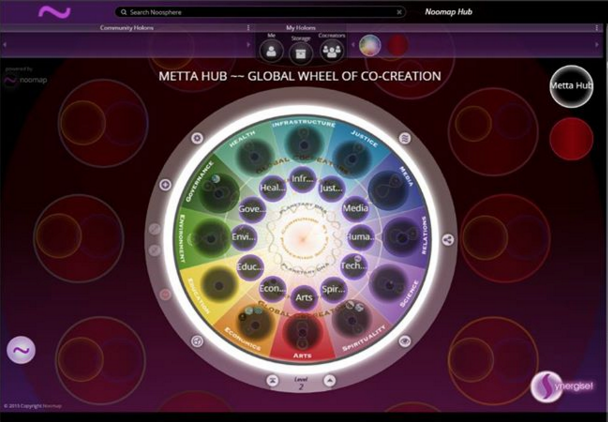
Here’s my reply:
Bret, the interface is elegant and beautiful as always what you guys do. But that’s the easier part. The trickier is to design the pattern language for organizing the collected data and a smart information architecture that doesn’t only prevent the users from getting overloaded by the sheer volume and complexity of everything recorded, but also help them creating new hyper-trails of meaning. It’s something like that what I’m aiming for in a collaboration initiated by Christina Bowen, focused on “creating a map of org-structure, practices, and theory to show/ learn impacts on individual behavior and expression of collective intelligence,” which you can find in the #org-ecology channel of ResponsiveOrg on Slack .
Ours is only one of the MANY similar mapping efforts. The very fact that there’s a growing number of such efforts is a sign of our times, of discovering the urgency of what Barbara Marx Hubbard wrote:
“The awakening of our species and our search for solutions is occurring, but it’s scattered, and it’s certainly not in dominion anywhere. The larger social structures are proving to be inadequate to solve the problems they’re creating. New social innovations are emerging everywhere, but they are not sufficiently connected or empowered. So right now, any effort that we can make to connect and create greater synergy and participation in this awakening process is probably the most important thing we can do.”
I don’t remember when she wrote that but I quoted it first 10 years ago here, and at numerous occasion since then, because it talks about a vital condition for our planetary evolution needs to carry itself forward.
In the ecosystem of global mapping efforts of transformational initiatives there are different species with different gifts to the whole. The one where I’m focusing my attention is not trying to catch everything that moves towards more compassion, cooperation, sustainability and creativity. There are zillions of such projects and previous mapping efforts that tried to portray them imploded under the very weight of the overwhelming richness and diversity of the landscape.
So my intention is to map a much smaller swath of the whole, only the initiatives aiming at reinventing organizations for supporting the well-being and evolution of all of their members and other stakeholders. Such initiatives are numbered “only” by the thousands which I find a more manageable number. 🙂
The infographic below is a first sketch for the landing face of such a map:
An ecosystem of movements for next-stage organization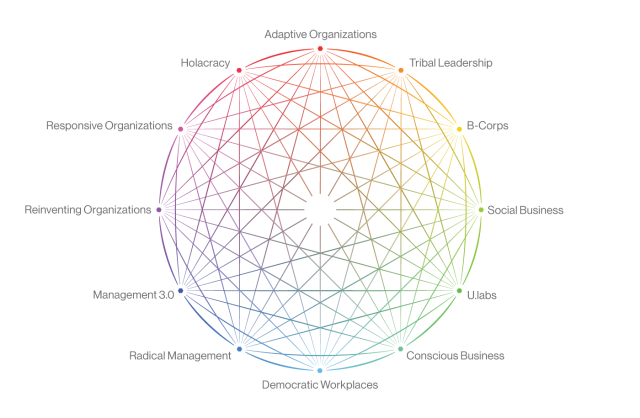
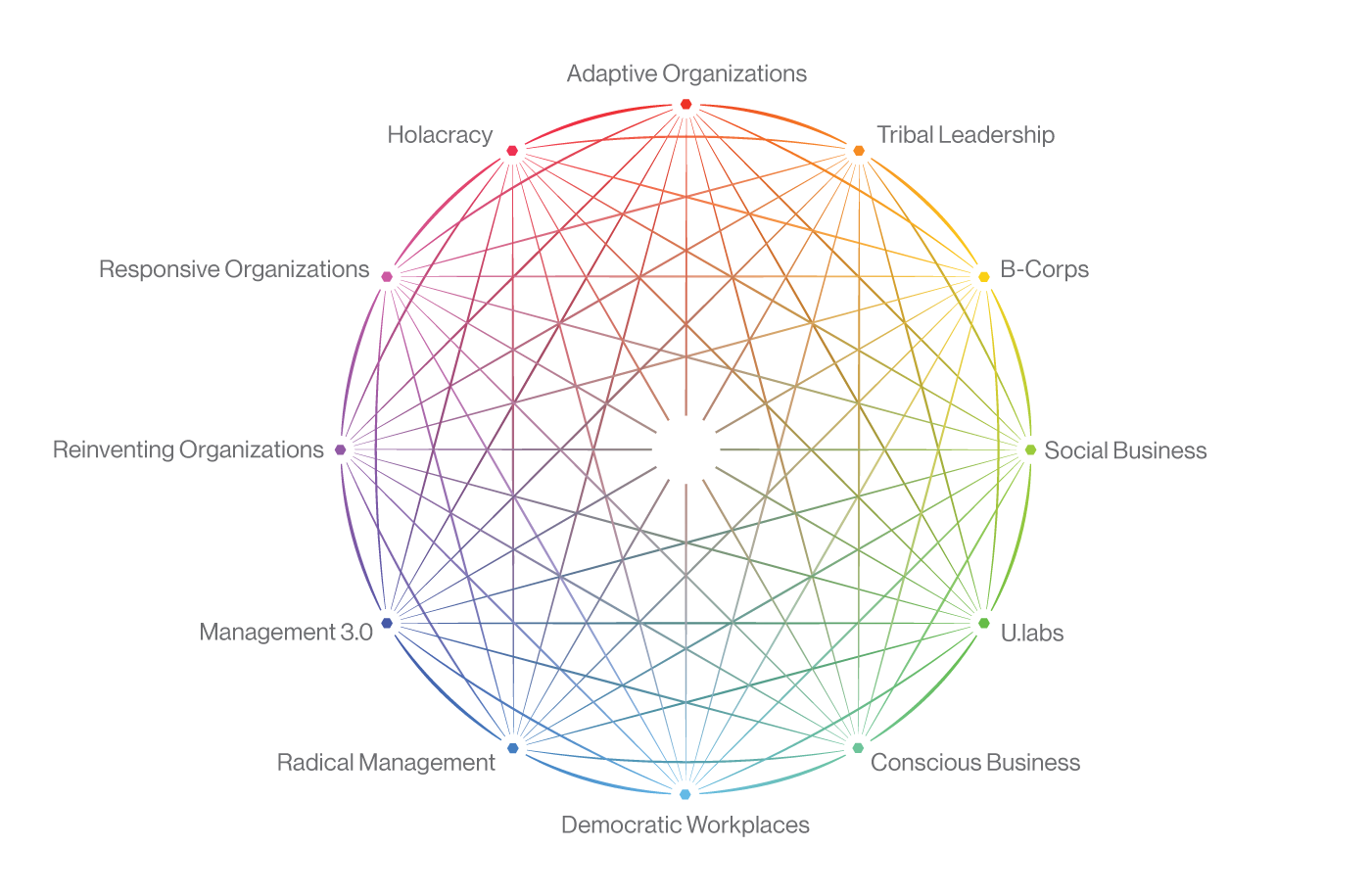
map concept by George Pór – rendering by Sebastian Martin
 This work is licensed under a Creative Commons Attribution-NonCommercial-ShareAlike 4.0 International License
 This work is licensed under a Creative Commons Attribution-NonCommercial-ShareAlike 4.0 International License
I wrote a bit more about the map above in the editorial of the September issue of Enlivening Edge.
Another mapping initiative worth paying attention to is the one of the Global Solutions Network:
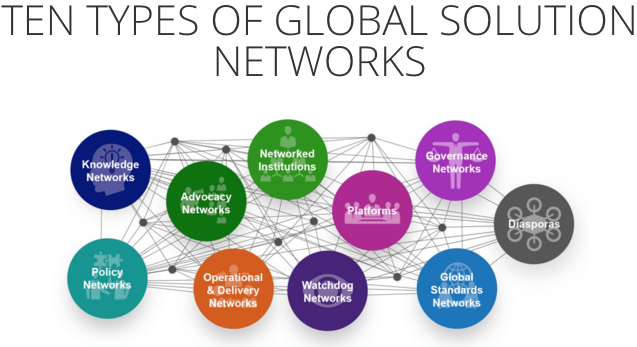
The 4 characteristics of a GSN are: addresses a global problem; engages diverse stakeholders; exploits the digital revolution; and self-organizes and self-governs. GSN’s core ideas is that “enabled by the digital revolution, multi-stakeholder, self-governing networks are transforming how we solve global problems.The 10 types of networks pictured above are linked with issue-based hubs that span climate and planet stewardship, health and human security, employment and prosperity, and cities. On each hub expert curators invite nominations of successful GSNs to help grow a comprehensive network of GSN networks.
GSN claims to be the definitive resource of expert insights, cases and field tools for global problem solvers. Its funders are large institutions and to get listed you have to be proven successful at a global scale. Very different logic from how the bottom-up, grassroots networks organize themselves. It’s not better or worse than the latter ones, just addressing different audiences. If you’re a forward-thinking policy maker, go to and engage with GSN.
If you’re a movement catalyst, organizational change maker, or connector of people networks, and want to increase your effectiveness by connecting with the tip of the evolutionary wave, then go to and immerse yourself with the Reinventing Organizations wiki and the community surrounding it. In that case, you may also want to pay attention to such new type self-managing and self-governing organizations as Enspiral, Metamaps, Sensorica, EdgeRyders and their brethren.
Technical folks from those groups are gathering, as we speak, and “scheming about what the fundamental technical aspects would be needed to enable a vastly more interoperable capability to our various web platforms.” Whether they will succeed or not is almost less important than the fact they have engaged in co-creative relationships for growing something that can “act more so as an ecosystem of tools, than siloed off platforms” (Connor Turland).
One of the questions that hold my attention, as I’m looking at their work, is what can the various projects of mapping “next-stage” organizational innovation learn from them? Can it be that facing challenges more complex than any group can successfully deal with inspires the recognition that when we meet things that are too complex to deal with, we need to ask for help from a larger collective intelligence? At some point in the development of our separate mapping projects we may recognize that there is no one method of mapping can do justice to the vastness of the tectonic shift between the dying old civilization and the emerging new.
At that point we’ll start turning towards each other, seeking interoperability. The sooner we reach that point the easier will be to have the maps talk with each other. Only then will their users, the people, communities, and organizations who need them, will have a more triple-E (more effective, efficient, and enjoyable) experience of navigating with them our turbulent, Emerging Planetary Reality.
Another important mapping effort was led by Rhonda Fabian and commissioned by Kosmos Journal:
Connecting for Change: Insights from an Emerging Global Transformation Movement
Based on research by the author, in collaboration with Jennifer Horner, PhD

“You might say it is the dark night of the planetary soul. Here we are in the midst of an ecological nightmare some are calling irreversible. The weight of war and human suffering seem overwhelming. We are bombarded with distress signals, but lulled by a media and political system that pushes distraction and more spending. Is it any wonder we try to evade our despair, that we close our eyes?
Yet at the same time, many people are waking up. They share a persistent inner sense that even the darkest night must be followed by a new day. Nearly every spiritual tradition says it is so and prophesizes a great planetary era still ahead and, though particulars differ, each asks for our faith that a better world is possible, predicated on peace and sharing. Science advances a similar, more immediate message: it’s now or never and cooperation is the key.
The Shift, Great Turning, and New Story are words used to describe what many are experiencing as a growing movement or awareness worldwide of the need to examine and restructure political, economic, and social systems to align more closely with the needs of humanity and the Earth.”
Kosmos Journal’s “Connecting for Change” study was one of the most substantive contributions to the field that I call “evolutionary cartography” that is focused on mapping the tip of the evolutionary wave of today’s epic transformations. Hopefully, the next phase of the study will receive the funding necessary to do justice to the complex tasks of mapping the fast-moving tip of the evolutionary transformations sweeping the world.
To be even more useful than Phase I was, Phase II of the study would need to organize and store its information, using a collaboratively developed “transformational movements” pattern language, maybe in a relational database at the back-end, and an engaging “advanced visual language”-based user interface as a publicly accessible front-end.
Coupled with social technologies (such as the U process, World Cafe, Appreciative Inquiry, etc.) baked in the software, Connecting for Change could become a fully self-organizing knowledge base and more — an engine of transformation, by connecting our conversations in the ecosystem, which i wrote about in Kosmos:
If what we aim at is to discover the generative patterns that connect the various movements and initiatives for change, then we need to create interactive, self-organizing maps with functions that I sketched out in a 2010 blog on A tool for mapping the future as it’s emerging in the present and What functions will élan map perform. 5 years ago, those thoughts were a decade ahead of their time. Let’s shorten the remaining 5 years. 🙂
But it’s not only about software and information architecture, and maybe not even about them at the first place. Rhonda wrote earlier this year, “We are coming closer as a species to a new form of mental connection. It is possible to mentor, support, hold one another very deeply.” I replied: And it’s not only mental. For our species to awaken to its collective sentience, the global brain needs to be coupled with a global heart. That’s the focus of the paper that I am working on presently, “From Shared Mindfulness to Collective Intelligence to Collective Sentience.”
Since then, that paper was published and you can read it here. It’s not hardcore futurism because the unscaled version of “collective sentience” is already present. Is is in caring for each other and this planet. Whatever mapping of the forces that work for a better world we develop, it should not be just an intellectual exercise. It needs to be guided by a desire to support all those to find a path to the future, who know that there must be an alternative to the status quo, and need to discover that not only they are not alone, but there’s a plethora of paths…
The Power of Collective Wisdom
In a world facing increasing complexity, ambiguity, and uncertainty, it is both good and necessary to be reminded of deeper truths and practical principles for creating lasting change. This book is for leaders, groups, communities, and networks desiring to increase our human capacity for creativity, well-being, and social change. This is a foundational book for anyone exploring the higher potential of groups or wanting to find personal ways of being a better leader, organizer, or collaborator. Readers will be impressed by the depth of insight and accessible style that offers both inspiration and practical real-world knowledge. “When you connect your dots, good things happen. When many find their dots interconnected, great things can happen. Collective wisdom doesn’t imply convergent thinking. An intra-connected group gains traction by respecting its members’ diverse perspectives. Intra-connected groups function with a picture window view, so decisions are based on what’s best for all.” Supported by the visionaries of the Fetzer Institute, this book is required reading for anyone interesting in collaborative social change. Based on nine years of research, The Power of Collective Wisdom shows how we can reliably tap into the extraordinary co-creative potential that exists whenever human beings gather together. The most significant challenges of our time- social, economic, and environmental- are calling for leaders to understand, trust, and draw upon relational and co-creative capacities. This inspiring and practical book points the way. Not only have authors written about collective wisdom, they have created it.
Posted in Collective Wisdom
Leave a comment
The Collective Intelligence of Online Communities
Recent research with face-to-face groups found that a measure of general group effectiveness (called “collective intelligence”) predicted a group’s performance on a wide range of different tasks. The same research also found that collective intelligence was correlated with the individual group members’ ability to reason about the mental states of others (an ability called “Theory of Mind” or “ToM”). Since ToM was measured in this work by a test that requires participants to “read” the mental states of others from looking at their eyes (the “Reading the Mind in the Eyes” test), it is uncertain whether the same results would emerge in online groups where these visual cues are not available. Here we find that: (1) a collective intelligence factor characterizes group performance approximately as well for online groups as for face-to-face groups; and (2) surprisingly, the ToM measure is equally predictive of collective intelligence in both face-to-face and online groups, even though the online groups communicate only via text and never see each other at all. This provides strong evidence that ToM abilities are just as important to group performance in online environments with limited nonverbal cues as they are face-to-face. It also suggests that the Reading the Mind in the Eyes test measures a deeper, domain-independent aspect of social reasoning, not merely the ability to recognize facial expressions of mental states.
Source: The Collective Intelligence of Online Communities | Learning Change
Posted in Academic Research in CI
1 Comment
 Blog of Collective Intelligence (since 2003)
You must be logged in to post a comment.